Showing posts with label Fun Stuff. Show all posts

Monday, August 12, 2013

New Fun Stuff

Because I was bored…now when you post a photo to Instagram and tag it #bkysr it will auto-upload to a folder where you can view everything that has been tagged starting now.  If you’d like to look at the pictures at any time, just click the following:  http://bit.ly/19oXlas
Or – you can click this handy little icon –>  instagram_logo_small

Wednesday, May 16, 2012

NPR.org - Shes 100 Almost And Still Swimming: Another Centenarian To Admire


We have a fondness for stories about centenarians, we have to admit.
There was Fauja Singh, the 100-year-old "Turbaned Tornado,"who finished the Toronto Marathon last year.
And we've posted about Tennessee's Evelyn "Mama Bird" Johnson, who died last week at the age of 102. She held the Guinness world record for most hours logged by a female pilot.
Marie Kelleher.
U.S. Masters Swimming
Marie Kelleher.
Now we're hearing about Marie Kelleher in Virginia, who at the age of 99 is still setting swimming age-group records. Counted as being 100 because United States Masters Swimming rules "use the swimmer's age as of December 31 for competitions held in 25-meter courses," according to Virginia Masters Swimming, she just became "the oldest known American woman to have competed at a USMS-recognized meet."
The Richmond Times-Dispatch says that "Kelleher swims four days a week, usually logging about 10 laps per session. She arrives at the Tuckahoe YMCA at 5 a.m. on her swimming days, driving herself 9 miles from her home to arrive exactly when the Y opens."
"I need the swimming," she told the newspaper, with a grin. "I'm not much at walking anymore. ... I told somebody recently that I staggered when I walk. He said that didn't sound too good. So let's just say I wobble."

Thursday, May 10, 2012

The Significance of a Team Travel Meet

Many of you (swimmers and parents) have often asked, or wondered, why we plan team-travel meets (athletes traveling as a group without their parents).  There are several reasons why the coaches feel this is important and feel that we should share these with you.
We are very fortunate to have a group of such dedicated and hard-working athletes.  There are many benefits that your swimmer(s) will experience from a team travel trip.  Often, these are dangled as “rewards” in front of swimmers to “inspire” them to attend practice, work hard, and “be good kids.”  We, and you, are blessed – they already do all of that!  While it is true that a team trip is a great “reward” and wonderful way to cap off a great season, there are many other benefits.
Team travel is a great way for our athletes to further bond their friendships, become closer to team members that they may not know as well,  learn to work together as a team, and discover the importance and satisfaction of representing their entire team and not just themselves.
Additionally, team travel presents an opportunity for young athletes to experience and grow their independence.  As coaches, we are committed to supervision of athletes at all times.  However, there are times when athletes will need to make decisions on their own or with guidance from someone other than their parents…just like the real world of college and employment.
Swimmers are often inspired by the performance of athletes at “new” meets.  Many times

Monday, April 30, 2012

Sleeping for Swimmers

What if I told you of a legal sports performance aid, involving zero out-of-pocket cost, and virtually no side effects. This aid can be used in high mileage or low mileage, IM or free, distance or sprint, age group or master. Too good to be true? The answer (as you judged from the title) is SLEEP!
There are two ways to improve in swimming: find ways to make yourself faster, and remove things that make you slower. Sleep deprivation is one thing that makes you slower. Adding sleep won’t make you faster than you are like a synthetic suit, but removing sleep deprivation can improve your training return on investment. (For additional discussion on sleep, see recent articles on Becoming a Morning Person, Jet Lag, and Diurnal Variation)
Swimmers are generally high achievers outside the water in school and at work. Other than a select few professionals who can train full time twelve months per year, a full time training load must balance with other “life” factors. As disciplined and highly motivated folks, swimmers usually find a way to cram everything in, with sleep often sacrificed. In fact, a culture of sleep deprivation is actually a badge of honor in many circles, particularly in academic settings and in the workplace. Swimmers are not immune to this form of informal competition, and often thrive!  

Wednesday, April 25, 2012

How to Become a Morning Person

G. John Mullen

Since we’re getting ready for morning practices, I thought I would send this out now so you can start planning ahead.

- LewisP

About John (HE’S AN OHIO SWIMMER !!!):
I graduated with a Doctorate in Physical Therapy from the University of Southern California in 2011. Although I have worked in various settings, most of my experience has been in with sports (ranging from Professional to Master’s athletes). At USC, I was a research assistant and worked on projects about physical activity and type II diabetes in Hispanic boys and lung adaptations in swimmers. I also coached at Southern California Aquatic Club, the largest Master’s team in the United States and worked as a personal trainer. In 2010, I started writing extensively being featured inSwimming World Magazine, SwimmerMagazine, and the Journal of the International Society of Swim Coaches. At this time I started a website to help congregate information on swimming research, Swimming Science and am on the advisory board for the International Society of Swim Coaches. I am also a Certified Strength and Conditioning Specialist with certification through the National Strength and Conditioning Association (NSCA).
I am originally from Centerville, Ohio. After graduating from Centerville High School in 2004, I attended Purdue University on a swimming scholarship and was an Academic All American Honorable Mention as well as a National qualifier. At Purdue, I helped manufacture a soy based clay pigeon, EcoDisc, which won numerous entrepreneurial accolades.
From sleep walking to sleep deprivation, I’ve tried it all. As a child, I was overactive which was present not only at day, but also at night. I would sleep walk every night, typically waking up in the recliner at our house, but sometimes even in our car!
My senior year in college I began manipulating my sleep to optimize productivity, who doesn’t want 100% productivity with minimal sleep? At the time, I was graduating from Purdue, swimming collegiately, starting a business, and socializing with the best of them. The only problem is sleep got in the way of all this fun. It was at this time I started waking up earlier and earlier. These times of sleep deprivation forced me to research everything about waking up early.
With all this research and personal trails, I have tried it all, as minimal as 3-hours of sleep at night. Through all these sleep trials, I have found a few keys to becoming a morning person. Follow these tips to make early traffic, hyper children, or running laps around the park more bearable!
 

No LED Screens

Make sure at least 30 minutes before going to bed you put down the electronics, turn off the TV, close the laptop, and perform something relaxing. Whether this is preparing meals for the next day, stretching, or reading, stay away from the LED screens as they excite the pineal gland which regulates arousal. On a side note, take the TV out of the bedroom, trust me, and if you don’t understand why, you can always e-mail me for more explanation.

MYTHBUSTER: BREASTSTROKERS MAKE THE BEST IMERS

4/16/2012

Ryan Lochte swims the breaststroke leg of the 400m IM at 2010 Nationals.BY KATIE ARNOLD//NATIONAL TEAM COACH FELLOW

If you are anything like me, your dreams of IM glory were crushed early in your swimming career because someone told you that breaststrokers make the best IMers (and like me, you were anything but a breaststroker). However, after doing some research on the subject, I am happy to report that you do not have to be a breaststroker to be an elite IMer.

During a moment of “what could have been” nostalgia, I looked at IM medalists from the past two Olympics. Out of the 13 unique medalists (8 female, 5 male), only one swimmer was ranked in the top-25 of a breaststroke event in the year they won their IM medal. However, of those same 13 swimmers, 2 were top-25 in a butterfly event, 4 were top-25 in a backstroke event, and 2 were top-25 in both butterfly and backstroke. The remaining 4 medalists were not ranked in the top-25 for any stroke event in that year.

While this should give hope to all you “non-breaststrokers” out there, it certainly does not mean you should stop working to improve your breaststroke. Because breaststroke is the slowest of the four strokes, IMers spend more time on that leg of the race than any other. To be an elite IMer, you need a solid foundation with good fundamentals in all four strokes.

Overcoming Mediocrity


Posted by Glenn Mills on Oct 15, 2011 07:29AM (1,661 views)

Over the past couple weeks, there have been a couple significant souls lost that made incredible impact on the earth.

Obviously, we all know about Steve Jobs, and those who visit here read about Al Weatherhead.  Read the third paragraph of the linked article to get some scope of understanding of Al.  I'm not writing this to further glorify these two men, but I refer to them for us all to imagine what is possible for humans.

When we think of what our own impact can be, if we were to only compare to people like Steve and Al, it leaves us all falling so short of any sort of impact, one could get very depressed with our own lack of contributuion to society.  It's a humbling experience to sit back and imagine.

However, both men wrote and encourage people to do the best we each could, with the understanding that not everyone has the ability to reach those heights.

When we think of swimming, we have to look at it very similarly.  What is our contribution to society as coaches, and what is our commitment as athletes that would be similar in any way to these great men?
Monday, April 9, 2012

Excerpts from an Interview with Cindy Tran

from the Swim Science blog
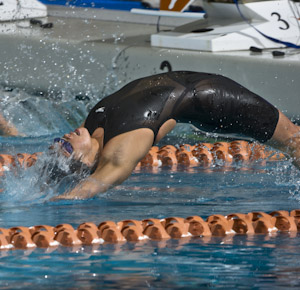
2011wncaa Cindy Tran wins the 100 backstroke at the 2011 NCAA championships.
What are you currently working on in your backstroke?
Well, I can always use work on the back half of my races. But that comes with more intention and focus in everyday workouts. Going into NCAA’s and into trials, where everyone has the potential to win, I was very focused on nailing my finishes and turns – trying to make them sharp and effortless. I think over ten years of bad habits has made it difficult to reverse them. Teri always says that whether we like it or not, we are always, always practicing turns and finishes in a workout, so you might as well practice good turns and good finishes.
What is the most common flaw between your good and elite backstrokers?
In very technical terms, elite backstrokers know how to hold good distance per cycle (DPC) with a consistently fast stroke rate. Personally, I struggle with keeping my stroke rate up when I get tired at the end of race. That’s where I can grow. Maximizing those two traits will lead to a optimum success.

Wednesday, April 4, 2012

Wilkinson, Winning, and the Game of Life

<p>Julia Wilkinson (The Canadian Press/Graham Hughes)</p>

Posted Tuesday, April 3, 2012 10:36 AM ET
Jennifer Lukas, CTVOlympics.ca Staff
Before she started winning Commonwealth medals, before she qualified and competed in six events at the Beijing Olympics in 2008, and before she started shattering Canadian records, Julia Wilkinson was just a local kid in Stratford, Ont., training in a minuscule four-lane, 25-yard pool.
"I think that I wasn't very good at the beginning. My mom tells this story about driving home from a swim meet and my sister had won a bunch of ribbons," Wilkinson told CTVOlympics a little over a year ago. "I said to my mom, 'Mom, everybody wins a medal at one time, right?'"
Wilkinson's mom, Mary, is an eighth-grade teacher.
"She said to me, 'Well, no honey. Some people, they win the ribbon of life.'" The 24 year old laughs as she remembers.
"I was like, eight. I don't understand metaphors at eight. But I just think that's funny now, because she didn't want to make me an empty promise.
Road to London: Read Swimmer Brent Hayden's Story
Eighteen years later, Wilkinson has won her share of ribbons. Decked out in a pair of flashy gold Ugg boots and gold nail polish at this week's Canadian Olympic swimming trials in Montreal, she has embodied the colour, winning three out of four races in commanding style.
The trials came close to becoming "The Julia Wilkinson Show," as the utility swimmer qualified for four Olympic events -- more than any other swimmer on the team. She could add two more depending on relay team selections at the Games in 2012.
"Swimming all these events is not as hard as four years ago," Wilkinson said on Saturday. "Four years ago I was so up and down and not sleeping. Now I feel great... It's experience and I learned that when you have a bad or great race you have to shake it off and move on."

Pool of Tears at Canadian Olympic Swimming Trials

(From the Toronto Star)
Image(6)
An emotional Annamay Pierse weeps after finishing a disappointing fifth in the women's 200-metre breaststroke and failing to qualify for the London Games at the Canadian Olympic swimming trials in Montreal on Saturday.
STEVE RUSSELL/TORONTO STAR
April 18 2007 Toronto: Randy Starkman Headshot for Logo Headshot. Staffheadshot.  (DAVID COOPER / TORONTO STAR)dac
By Randy Starkman Olympic Sports Reporter
MONTREAL—Oakville teenager Tara Van Beilen promised herself she’d keep her tears inside this time. World record holder Annamay Pierse was not so fortunate.
The women’s 200-metre breaststroke lived up to its billing as the event to watch at the Olympic swimming trials, pitting Pierse against world bronze medallist Martha McCabe of Toronto and the deepest world-class field here, including the fast-rising Van Beilen.
Pierse has struggled since setting the world record at the 2009 worlds in Rome. She had trouble adjusting to the change in swimsuits and suffered serious illnesses, including dreaded dengue fever at the 2010 Commonwealth Games.
She’d been unable to push herself in training the way she wanted and her worst fears were realized in finishing a distant fifth behind the 1-2 performance of Van Beilen and McCabe, who posted the second and third fastest times in the world this year.
Pierse was inconsolable. Tears streaming down her face, she talked to the reporters in the press room afterwards with her boyfriend, Olympic kayaker Mark Oldershaw, at her side.

Canadian Swimmer Julia Wilkinson

Breaking the 1-minute barrier

By Julia Wilkinson
Posted: Friday, March 30, 2012 | 10:30 AM
Read 0 comments0
Image Julia Wilkinson celebrates after winning the women's 100-metre backstroke at the Canadian Olympic Swimming Trials on Wednesday. (Paul Chiasson/Canadian Press)

I am no stranger to delayed gratification.
It's the life of a swimmer, at least after your 13th birthday when you stop dropping time every time you hit the water.
Every year, I spend countless hours training, but I am only in peak race preparation maybe twice every season. I spend a long time working on the details, with my fingers crossed that what I am doing will translate to my race by the time I taper.
That is why, after four long years of waiting, it was so sweet to finally break the one-minute barrier in the 100-metre backstroke en route to qualifying for my second Olympic team. That's right: I'm officially London-bound!
It's only day three of the six-day competition, and we have seen what Olympic trials are all about. In the first event on day one, my young (18-year-old) teammate from the Victoria Academy of Swimming, Alec Page, won the 400m individual medley and saw his Olympic dream come true. When I saw that he had defeated the field and qualified for the team, I thought my heart was going to explode with pride. Alec is a swimmer who loves to race, works harder than almost everyone I know, and has so much talent it's scary.

Monday, December 26, 2011

Interview with David Nolan

Here's a great interview with David Nolan from Pennsylvania.  David set FOUR national high school records before heading off to Stanford this fall.

The interview is a little long, but it's a great interview.  Also, if you look off to the side, you can find links to his swims at the PA State High School Championships.  He has some interesting things to say about practice that some of you might relate to.

CLICK HERE

Saturday, November 26, 2011

Swim Sci: Friday Interview with Gracie Finnegan

Here's an interview with Cow-Town girl, Gracie Finnegan!

Swim Sci: Friday Interview with Gracie Finnegan: 1) Please introduce yourself to the readers (how you started in swimming,education, experience, etc.). My name is Gracie Finnegan, I am 19 ...

Friday, November 25, 2011

Ned Reeb Q & A

Some of you (parents and swimmers) have asked some very good questions about the Ned Reeb meet (December 10, 2011).  Here are some things to keep in mind:

Q - Who does the entries?
A - Your high school coach is in charge of the entries.  This is a high school meet and your high school coach is responsible for submitting entries to the meet host (COSA) for the meet.  You will need to make them aware of your best times in your events if you have not already done so.  If you need a report of your best times, please download them from the BKYS website or ask Laurie or Lew for a print-out.


Q - What suit do I wear?
A - You should be wearing your high school suit.  Since this is a high school meet and not a USA (BKYS) meet, your high school team suit is the appropriate suit to wear.  Your high school coach may allow you to wear a Fastskin or LZR; however, we would not suggest that you do that - save it for Sectionals / Districts / States.

Q - Is this a big meet?
A - Um...yeah, it is.  Here are some statistics from last year:

  • There were 800 athletes entered in the meet - an exact 50/50 split Male / Female
  • Female - 17.3% Freshman, 28.4% Sophomores, 27.3% Juniors, 27% Seniors 
  • Male - 13.6% Freshman, 23.2% Sophomores, 28.5% Juniors, 34.7% Seniors 
If you have any other questions that aren't answered here, please let Laurie or Lew know.

Sunday, November 13, 2011

Jason Lezak Gets "Fitted"

I'm still friends with my tailor from California (Facebook can be a great thing).  He sent me a message that he'd altered a suit for Olympic gold medalist Jason Lezak and had a photo of him in the suit.  Here's the photo:


Scott is 5'9 or 10.  I'm guessing he had to let the hem out of the pants, relax the chest under the arms, lengthen the sleeves, let out the back seam of the jacket, and take the waist in about 4 inches.  I'm not sure how I feel about the matching pocket squares...
I ran into Mr. Lezak (literally...ran into him) at Barnes & Noble in Irvine.  I had to look up (and up, and up) to apologize for bumping into him.

Friday, October 28, 2011

By Dan McCarthy//National Team High Performance Team

Most swimmers go into races of 200 meters or longer with split goals; however without having a corresponding stroke cycle target, an athlete’s work is incomplete.

A perfect example of how focusing on just race pace can go wrong is seen every weekend at competitions around the country when the pace lane opens. An athlete swimming the 800 with split goals of 1:00.0 can achieve those splits with many different strategies; however, the only one that is going to work is if the athlete repeats the pace and cycle count they expect to have during the race. Practicing a 1:00.0 pace with two or three more cycles per 100 than they are able to physically maintain in a race will not properly prepare an athlete for competition. Additionally, holding a faster pace than an athlete’s goal with a high cycle count that they cannot maintain will have them all out of sorts during the race.

Race pace sets in training are the perfect opportunity to train not just the pace, but the stroke cycle count as well. Once the goal stroke cycle count has been established for an athlete, the set can be designed to make maintaining the goal split and stroke cycle count progressively more challenging, but consistent with the overall race strategy.

Below is an example set for an athlete with a pace of 1:04 per 100 meters and 40 stroke cycles per 100. Swim two or three rounds:

1 x 50 @ 1:00 hold :32 and 20 stroke cycles
1 x 100 @ 2:00 hold 1:04 and 40 stroke cycles
1 x 50 @ :50 hold :32 and 20 stroke cycles
1 x 100 @ 1:40 hold 1:04 and 40 stroke cycles
1 x 50 @ :40 hold :32 and 20 stroke cycles
1 x 100 @ 1:20 hold 1:04 and 40 stroke cycles